DDF
· Report talkshow How Design Works, by Niels Guns
How Design Works: integrale innovatie begint bij menselijke waarden
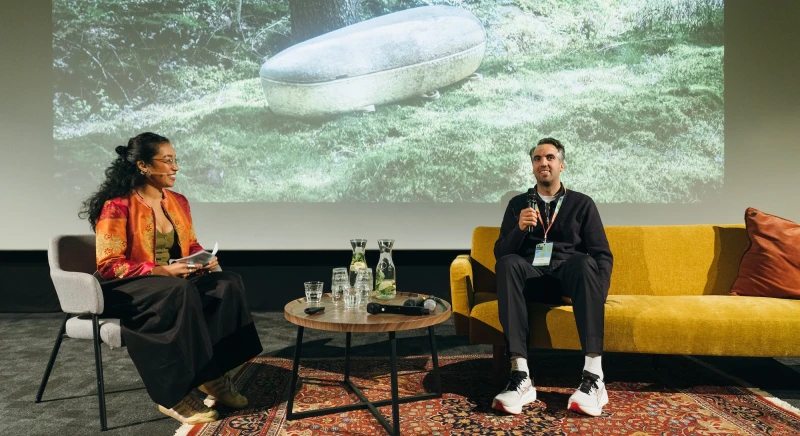
How do you ensure that innovation not only works from a technical perspective, but also creates real value and finds its place in society? This question was at the heart of the second edition of the How Design Works talk show, organised by Dutch Design Foundation and the Dutch Ministry of Economic Affairs on 23 October during Dutch Design Week (DDW) 2026 at Natlab in Eindhoven. Centred on the theme of integrated innovation, the event brought together policymakers, researchers, entrepreneurs and designers to share their experiences.
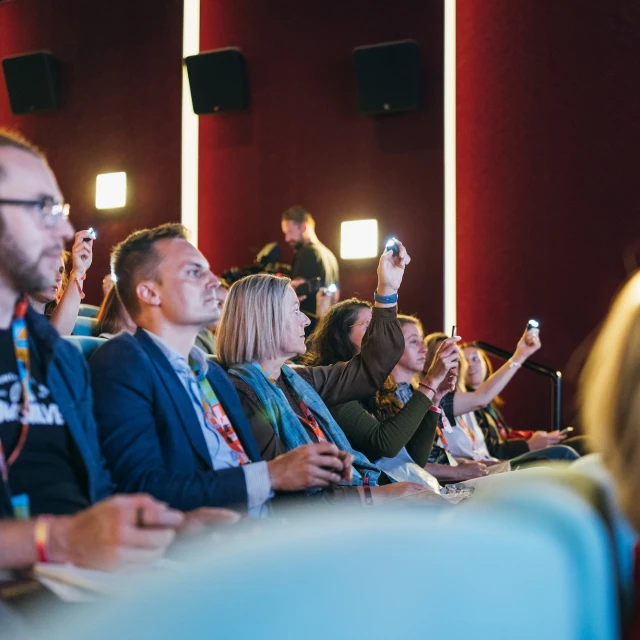
Moderator Tiara Spalburg, innovation designer at grid operator Alliander, warmed up the audience with a game of Chinese whispers. The sentence ‘Integrated innovation is successful when the researcher, the civil servant and the neighbour have lunch together’ was whispered from person to person. By the time it reached the end of each row, the sentence had usually become distorted.
Spalburg then explained what integrated innovation means to her: “An approach to innovation that looks beyond a single interest, solution or discipline and considers the entire system surrounding it.” According to Spalburg, this is essential if we want to act on human values. “A technological solution can be brilliant and still go unused. Today, we’re exploring how the power of design can help accelerate innovation, move organisations forward and make meaningful progress on societal challenges.”
A seat at the table
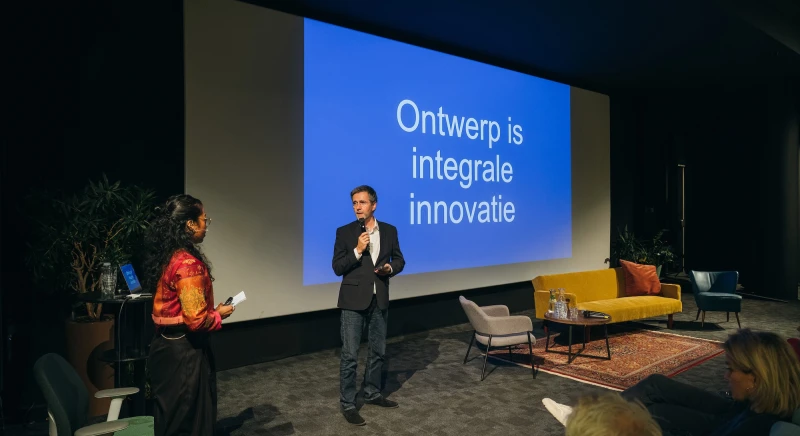
Bart Ahsmann, director of innovation organisation CLICKNL, opened as the first speaker with the statement ‘Design is integrated innovation’. While he acknowledged that this was somewhat of an oversimplification, he had deliberately chosen this wording to highlight the role of design within the innovation ecosystem. Ahsmann referred to the European Action Plan for Design-Driven Innovation from 2013, which had already concluded that “Design is a less costly alternative to R&D for many SMEs.” According to Ahsmann, this conclusion remains just as relevant today.
He therefore made three calls to action for policymakers and designers. First, he called for more appropriate funding mechanisms, as the service-oriented nature of designers’ work often does not fit within existing funding structures. He also argued that support should be provided simultaneously at European, national, regional and local levels. Finally, he stressed the need to build a stronger evidence base for design processes: “There are plenty of case studies, but translating them into evidence that can be applied more broadly remains a major challenge.” His message to designers was therefore to focus not on showing how beautiful something is, but on demonstrating the actual change their work brings about or has already achieved.
From steel to language
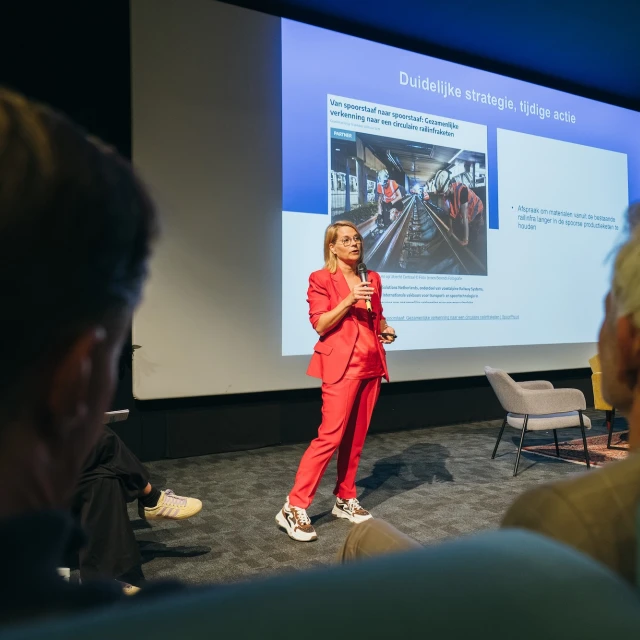
Lotte de Groen, Market Director at TNO Vector, demonstrated how the production process itself can also be designed. She used ProRail as an example, which replaces railway tracks approximately every thirty years. Producing green steel rails is technically possible, but achieving the sustainability target requires at least 78 per cent scrap steel. Yet scrap steel is becoming increasingly scarce. TNO Vector therefore investigated which players across the European supply chain would need to be involved and what strategy ProRail could adopt to secure a reliable supply of scrap steel. Although ProRail initially considered itself too small to negotiate agreements with major European players, De Groen explained that these companies actually welcomed a partner capable of experimenting quickly.
Her second example was GPT-NL, a Dutch AI language model designed around societal values. The model is trained exclusively on lawfully obtained data, is transparent about the training data it uses and ensures that a share of the revenue flows back to copyright holders. This makes it an alternative to other large language models, particularly for legal professionals and healthcare organisations working with sensitive data.
De Groen concluded with three key lessons: broaden the scope of the challenge early on, make design decisions collaboratively and develop the capacity for continuous learning. According to her, the latter cannot be learned from a handbook: “We have already learned so much in the Netherlands about integrated innovation, societal innovation and how to make innovation succeed. It would be a real shame to lose that capability by trying to capture it all in handbooks. It remains essential that we continue learning from one another, person to person.”
Building what people need
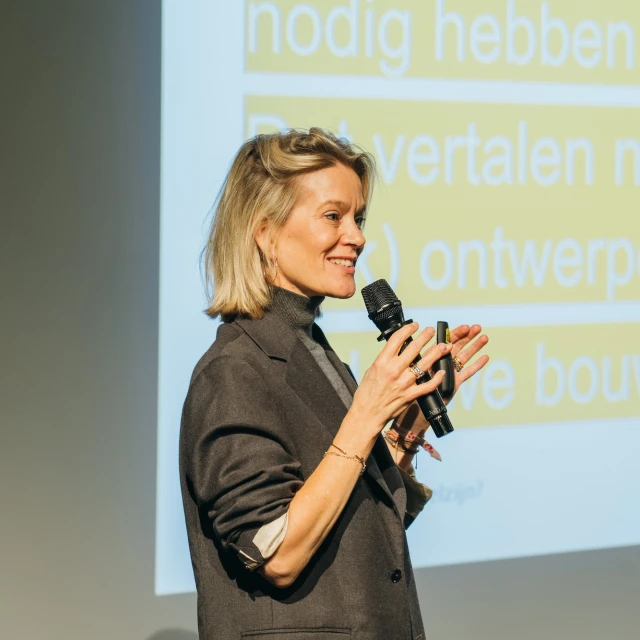
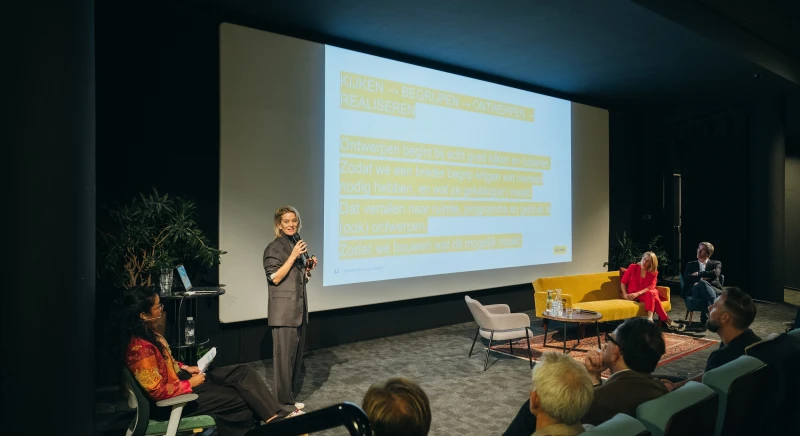
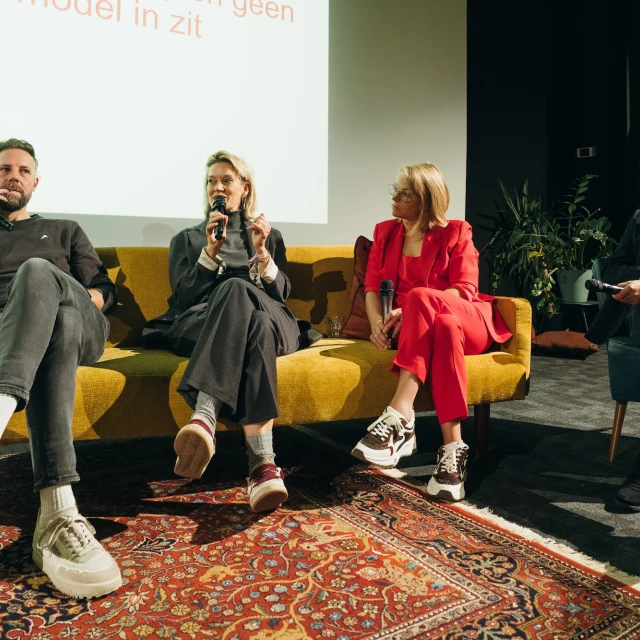
“You can design a home that meets all the regulations and building standards, but that doesn’t necessarily mean you’re creating a pleasant living environment,” said Lonneke Zuidwijk, Director of Real Estate at Heijmans. She referred to the Bijlmermeer, once presented as the city of the future, where 40,000 ‘ideal’, efficient homes were built. Yet meeting technical specifications alone did not create a neighbourhood where communities could truly take root and thrive.
According to Zuidwijk, focusing on wellbeing is far from optional. Loneliness costs Dutch society around €2 billion a year, she pointed out. “And healthcare and wellbeing are among the largest areas of expenditure in the national budget and many municipal budgets.” It is therefore essential to consider not only what is technically possible, but also how people want to live, how they want to feel and how they want to live together. Or, as Zuidwijk highlighted on one of her presentation slides: moving from what is possible to what is possible × what people want.
Together with TNO and Utrecht University, Heijmans developed an impact assessment tool that identifies the most relevant issues for each area. In Hellevoetsluis, for example, the assessment revealed concerns about young people's mental health. Heijmans subsequently brought together municipal professionals working in the social and physical domains. “They hadn’t even met before. To me, simply bringing people together can sometimes be innovation in itself.”
Using the field guide De wijk in het wild, Heijmans employees go out into neighbourhoods to observe and engage with residents, while consciously challenging their own assumptions and biases. The insights they gather are then translated into design solutions using intervention cards.
One example is the communal access gallery at Sumatrahof in Leiden’s Zijdekwartier neighbourhood. Rather than creating a cold, functional corridor where residents have little reason to linger, the gallery has been designed to encourage people to stop, meet and have a chat.
Reason and emotion
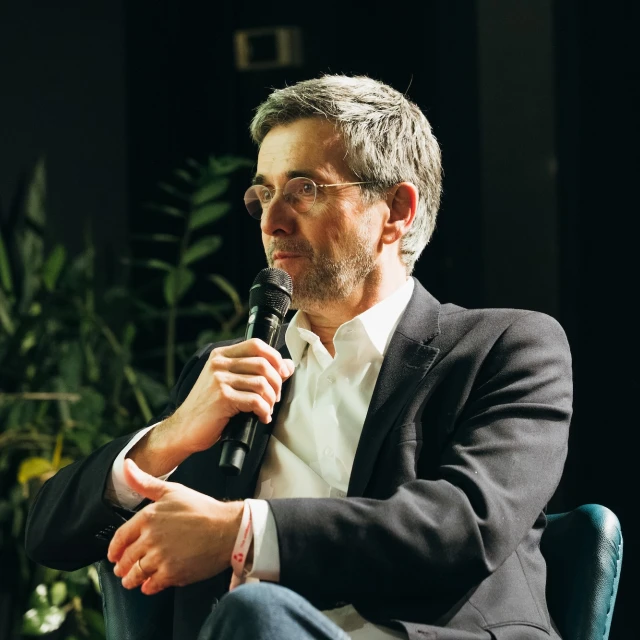
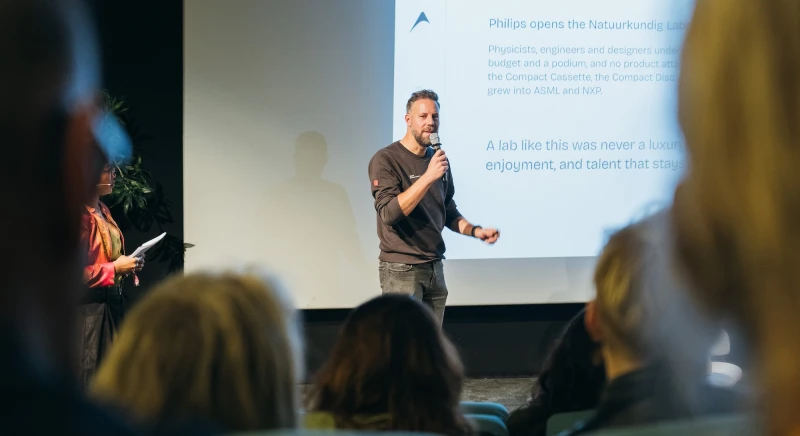
Albert Maas, founder and CEO of Eindhoven-based robotics company Avular, argued in the next discussion that technology and design have grown apart in Europe. Engineers tend to focus primarily on specifications, while people, he believes, make purchasing decisions based on emotion, even in the business-to-business market. “Reason is merely a tool. But emotion alone is fashion, and can be very fleeting.” According to Maas, it is only when both aspects come together in a single design that products emerge which people truly want to connect with. He compared it to dating: specifications might get you the first date, but design is what gets you a second.
Maas also reflected on the venue hosting the talk show. In 1914, Philips opened its Natuurkundig Laboratorium (Physics Laboratory) here. Physicists, engineers and designers worked together under one roof, creating the conditions for innovations such as the cassette tape, the CD and the early research that eventually led to companies including ASML and NXP. According to Maas, this kind of freedom to experiment has been sacrificed in favour of short-term profits. His message was therefore clear: dare to dream, dare to fail and dare to invest in talent, technology and design simultaneously.
During the panel discussion that followed, Zuidwijk and Maas spoke about the autonomous road roller that Heijmans and Avular are developing together. According to them, the innovation addresses both labour shortages and the risks associated with working alongside motorways. Before developing the machine, Avular first asked the operators whether they actually wanted it to exist.
Zuidwijk emphasised that design is not always a linear process: “You have to slow down before you can speed up.” Maas, meanwhile, called for a greater willingness to challenge conventions: “Go against the grain.”
What does the mushroom want?
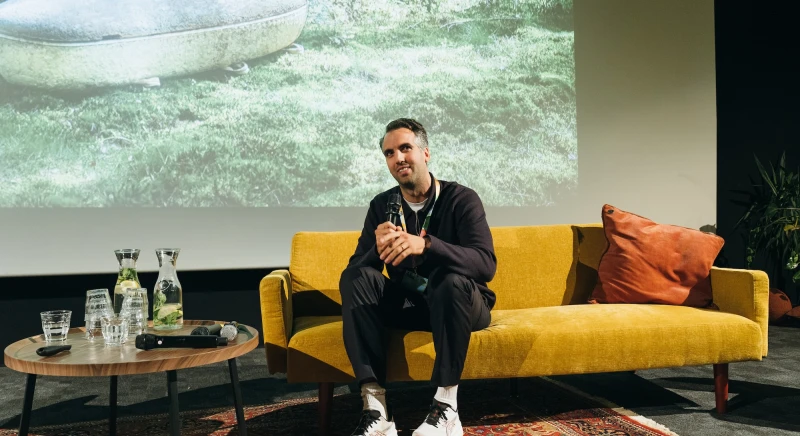
In the second session, How Design Operates, Loop Biotech founder Bob Hendrikx explained how his graduation project at TU Delft’s Faculty of Architecture grew into a company. Hendrikx described how he had long been fascinated by mycelium as a material. “At first, I thought: I want to build a house with it. But gradually, I started asking questions like: what does the mushroom actually want? I think that was also the moment my professors thought: ‘This guy has lost his mind.’”
But Hendrikx persevered and continued exploring the possibilities. The result was the Living Cocoon, a coffin made from hemp fibres and mycelium that grows in a mould in just seven days. After burial, rather than polluting the soil, it actually enriches it. Loop Biotech has now supplied coffins to nearly 10,000 families across Europe, the United States, Canada and, more recently, Australia.
“That also led to some beautiful stories. The material is initially quite soft before it hardens. I heard about people who started hugging the coffin with their deceased loved one inside.” The coffin costs €1,500, Hendrikx explained, while comparable but far less sustainable coffins range from €800 to €3,000, according to him.
Hendrikx also shared his ambition to establish production facilities on three continents, which would require around €40 million in investment. Despite extensive international media coverage and an overwhelmingly positive response, achieving this goal has proved far from easy. Along the way, Hendrikx has learned that idealism alone is not enough: “But if you keep taking small steps, you really can make progress.”
A chair you can’t buy
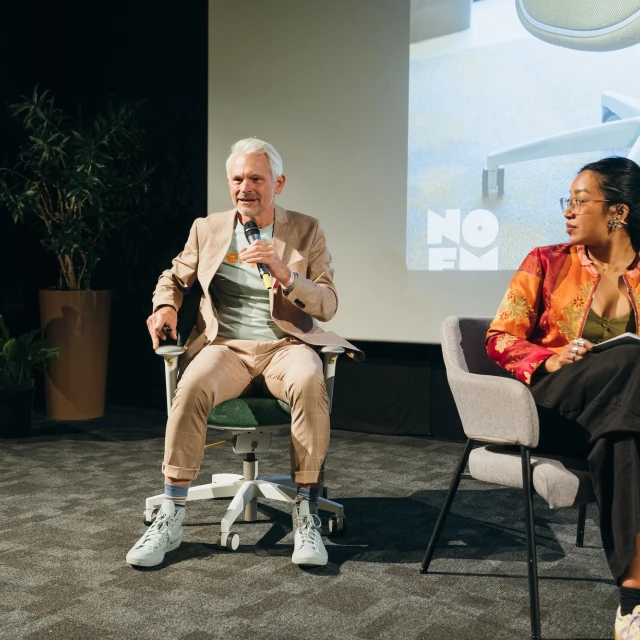
The final speakers of the talk show were designer Robert Bronwasser and Patrick Lems, founder of NO-EM. Together, they developed the circular Infinity office chair, which they exhibited at Dutch Design Week (DDW) and which won a Red Dot Award earlier this year. Unlike traditional office chairs, the Infinity chair is not available for outright purchase. Instead, users pay for its use, with the revenue shared across the entire value chain. Bronwasser, for example, receives royalties every time the chair is resold, while the manufacturer refurbishes chairs or components rather than constantly producing new ones.
“In a way, we had to redesign the entire business model as well. This involved extensive discussions with various stakeholders. If you want to reduce CO2 emissions, you need to minimise production and recycling processes while maximising the product’s use. But achieving that requires the involvement of the entire value chain,” Lems explained.
Through his efficient design, Bronwasser also stripped the chair back to its essentials. As a result, it weighs just 13 kilograms, significantly less than the average office chair, which weighs between 20 and 25 kilograms. “It was also quite a challenge to design a chair that would remain aesthetically appealing throughout its entire lifespan, but I think we’ve managed to achieve that too.”
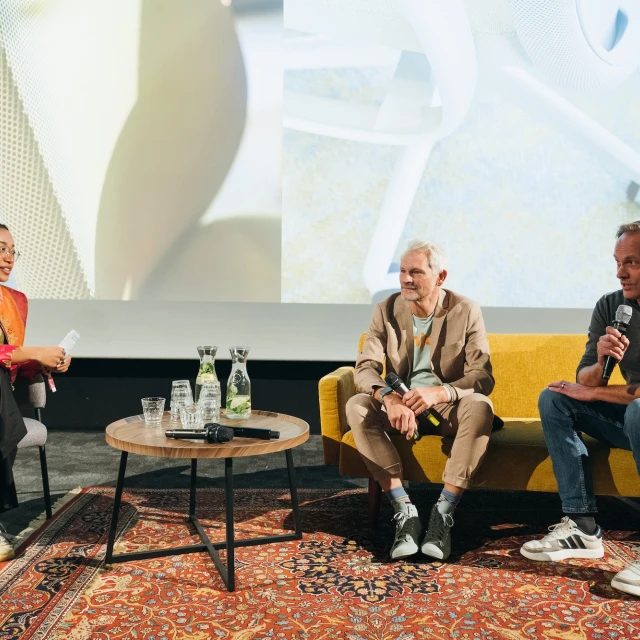
To conclude, Spalburg shared the value that matters most to her: justice, for both people and nature. She encouraged the audience to design rules and processes around such shared values. “I hope we stop putting our institutional interests or short-term goals first, and instead continue working towards what we truly want to achieve as human beings. We can then design rules and processes around those ambitions that help us stay true to our values.”